Customs, not rules
Weddings in Russia and Ukraine mix religious rites, folk traditions that predate Christianity, Soviet-era practices and, increasingly, international habits such as white dresses, photographers and destination ceremonies. A couple in Kyiv or Moscow may keep every old custom, only a few, or none at all. This guide describes what you may see, so that nothing surprises you and so that you can ask informed questions. It does not describe what any particular family expects, which only the family can tell you.
Two ceremonies: civil and religious
In both countries, a marriage is legally created by a civil registration. The civil office registers the couple and issues the certificate. A church wedding, if the couple has one, is an additional ceremony and does not replace the registration. Many couples have a short civil ceremony, a church blessing on the same day or later, and a large reception.
The details of the civil process differ between the two countries, change over time and depend on the citizenship of each partner. For a marriage involving a foreign citizen, do not rely on an article: consult the registry office of the country where you plan to marry, the relevant embassy, and an immigration lawyer if a visa is involved. The marriage of two people from different countries raises questions about documents, translations and recognition that this site does not answer.
The wedding day, step by step
The following sequence is traditional, and usually adapted.
1. Matchmaking and meeting the families
Historically, a groom’s family sent matchmakers (svaty) to the bride’s parents to ask for her hand. Today, this survives mainly as a ceremony, sometimes played for fun: the groom and his relatives visit the bride’s parents formally, bringing gifts, and are received with food. If you are in a relationship with a woman from either country, meeting her parents is an event. Bring flowers for her mother, a small gift for the household, and treat the family with respect.
2. The ransom of the bride
On the morning of the wedding, the groom traditionally comes to the bride’s home to collect her. Her friends and family block the way and set tasks: answer questions about her, sing, pay with sweets, money or small gifts. This is the ransom (vykup in Russian, vykup in Ukrainian). It is a game, usually humorous, played with teasing questions, forfeits and a good deal of laughter. The groom is expected to be a good sport. The bride’s family usually yields once the groom has shown he is willing to make a fool of himself for her.
3. Bread and salt
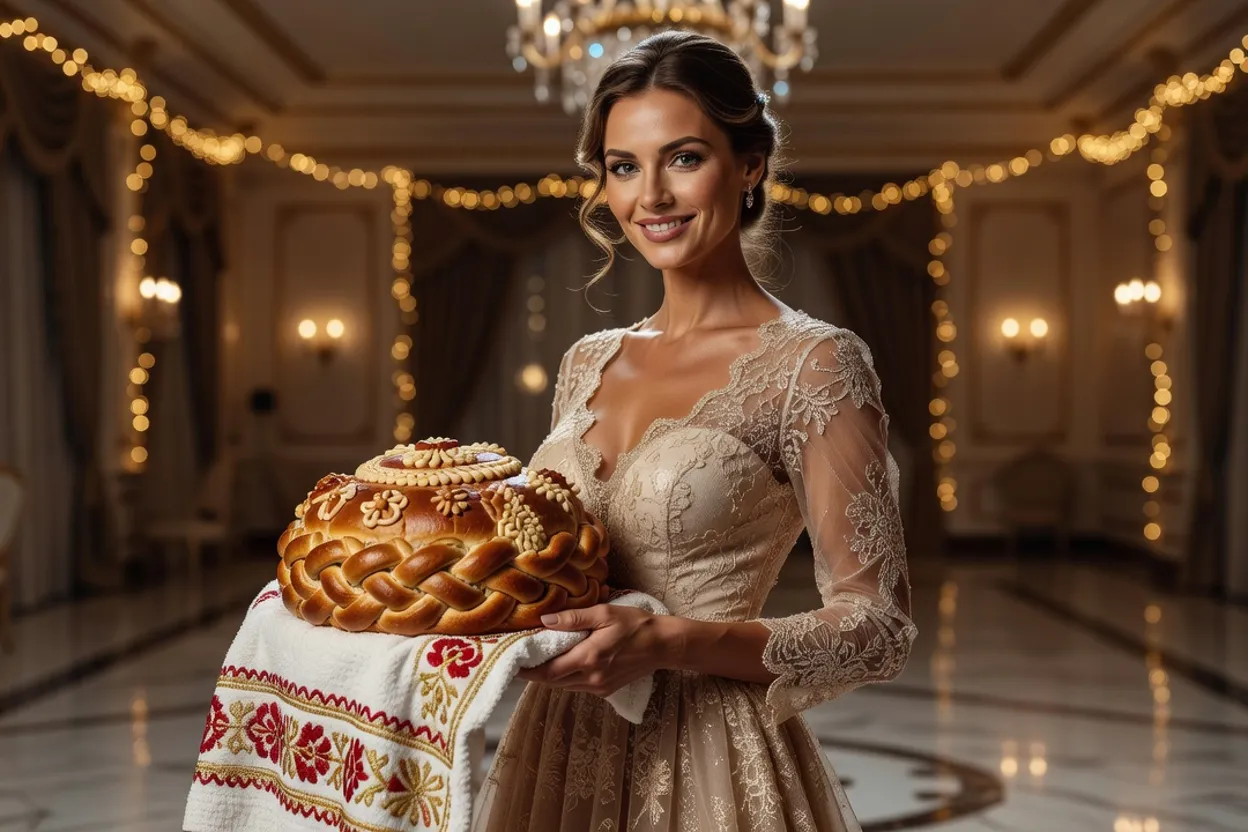
In both traditions, parents greet the newlyweds at the door of the reception, or at their home, with bread and salt. The loaf is a large decorated wedding bread, called korovai in Ukrainian and karavai in Russian. The couple bites or breaks off a piece, dips it in salt and eats it, and the one who bites more is said, in a playful tradition, to be the head of the household. It is a symbol of hospitality, prosperity and welcome, not of a power contest, and most couples treat it as a joke.
4. The embroidered towel
In Ukrainian tradition, the rushnyk is a long embroidered ritual towel. It appears at births, weddings, funerals and when welcoming guests. At a traditional wedding the couple may stand on one so that, according to the old belief, they begin life together on a good footing. The pattern and colours vary by region; red is common. Similar towels exist in Russian and Belarusian tradition, though the customs differ.
5. The ceremony
The civil registration is short, with a few formal words and the signing of the register. A church wedding in the Orthodox tradition has its own ritual: the couple holds candles, wears crowns, and walks around the lectern while the priest reads the service. Both the crowning and the walk are symbols of the union. Guests may attend the church service, but they are not obliged to take part.
6. The reception: toasts, games and food
Receptions can last many hours. They are led by a master of ceremonies (tamada or vedushchiy), who runs toasts, games and dances. Guests shout “Gorko!” (“Bitter!” in Russian) or “Hirko!” (Ukrainian), at which the newlyweds must kiss to sweeten the drink. There are songs, speeches, group dances, comic contests and often a lavish table of dishes like those described in the guide on holidays and the table. Gifts are usually money in an envelope or household items.
A guest who is asked to give a toast is not expected to deliver a masterpiece. Say something warm and short, wish the couple health, happiness and patience, and sit down.
7. The days afterwards
Traditionally, the celebration continued the next day with more gatherings, a custom known by different names from one region to another. Today, many couples keep it to one day and then take a honeymoon.
Comparison at a glance
| Element | Russia | Ukraine |
|---|---|---|
| Legal marriage | Civil registration | Civil registration |
| Religious ceremony | Orthodox (and other faiths) in addition to civil registration | Orthodox, Greek Catholic, Roman Catholic and other faiths, in addition to civil registration |
| Bread and salt | Common, usually a decorated loaf (karavai) | Common, and very closely identified with the wedding |
| Embroidered towel | Used in some regions | Central symbol, widely known as the rushnyk |
| Wedding dress | White Western-style dress is typical in cities | Same, with embroidery or a vinok wreath sometimes added |
| Toasts | Led by a master of ceremonies | Led by a master of ceremonies |
| Bride ransom | Widespread, playful | Widespread, playful |
If you are invited as a guest
A wedding invitation, or an invitation to a family celebration, comes with a few habits worth knowing in advance.
- Dress up. Guests in both countries generally dress smartly. For women, a dress; for men, a suit or at least a jacket. Arriving in casual clothes can be read as disrespect.
- Bring an envelope. Money in a card or envelope is the usual gift, often with flowers for the bride. The amount is a private matter and depends on the family and your relationship to them.
- Do not arrive late. Receptions run long, but the start time is usually respected for the ceremony.
- Expect to be asked to dance and to join the games. Join in with a good humour. Standing at the side with your arms crossed is the one thing you should avoid.
- Pace your drinking. Toasts are frequent. It is acceptable to raise the glass and take a small sip, or to drink a non-alcoholic alternative; hosts will generally understand.
- Say thank you to the parents. A few warm words to the mothers and fathers on both sides are always appreciated.
What is changing
- Fewer, smaller weddings. Many couples now have a modest registration followed by a dinner for close family and friends, rather than a two-day event.
- Personal choices. Couples choose which customs to keep: some skip the ransom, some skip the bread, and many choose a photographer and a venue as in any other country.
- Wartime weddings. Since 2022, news reports have described many couples in Ukraine marrying quickly, with short and simple ceremonies, because of the conditions of the war.
- Embroidery as identity. In Ukraine in particular, couples increasingly wear vyshyvanky or incorporate embroidery in their clothing, as a statement of belonging.
Family: who is involved
In many Russian and Ukrainian families, a relationship is not only between two people. Parents, grandparents, siblings and close friends form a network of opinions and help. This tends to show up in a few ways:
- Family meetings come early. Meeting the parents is a significant step, not a formality.
- Grandparents often help with children. Multi-generational support is common.
- Hospitality is expected. A visit to a family home involves food, long conversation and gifts.
- Opinions are shared freely. Advice from relatives, and sometimes criticism, comes with the territory.
None of this is unique to these countries. What is useful to know is that “meet my family” is a more serious invitation than it might be elsewhere. Accept it warmly and honestly, and do not promise anything you are not ready to deliver.
Realistic expectations for a cross-border couple
A few honest points, since weddings are the end of a long road:
- Distance is the main obstacle. The war has made travel to Ukraine impractical for many foreign visitors, and rules on leaving the country limit what some Ukrainians can do. Couples often meet in a third country. The guide on dating during the war explains the practical side.
- Paperwork is slow and country-specific. Marriage between citizens of different countries involves documents, translations and visa rules that change. Use official sources.
- Culture is only part of the picture. Shared values, honesty and patience matter more than whether you both know the same toast.
- Money is a warning sign when it comes early. A partner who asks for money before you have met is a reason to stop and read the guide on scams linked from the war guide.
For a French-language perspective on marriages between Russian women and Canadian men, the Quebec site Top site rencontre has an article on the subject.
Summary
- A wedding combines a legal civil registration, an optional religious ceremony and a reception with many traditions.
- Bread and salt, the ransom and toasts are widespread; the embroidered towel is especially Ukrainian.
- Modern couples choose what to keep.
- Families play a central role, and meeting them is a milestone.
See also holidays and the table for what you may be served, and languages, names and identity for how to address the family.