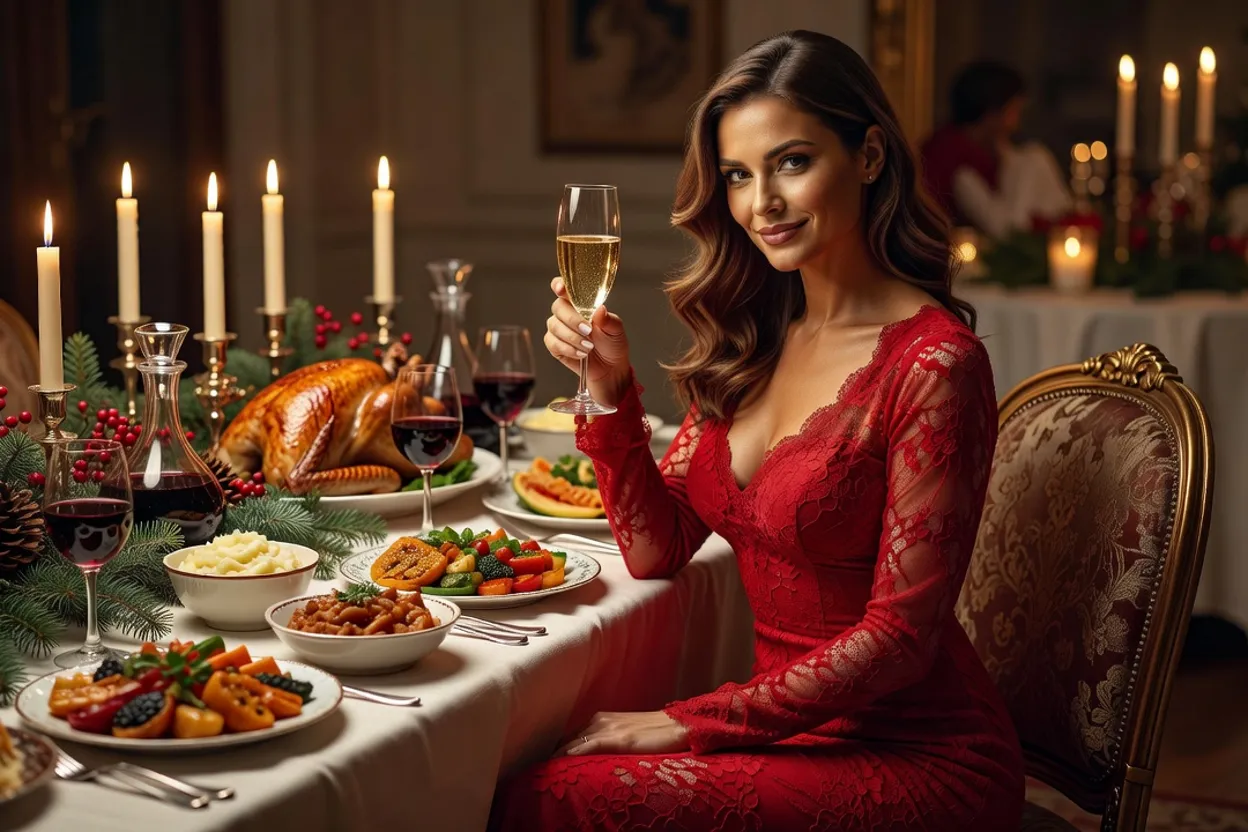
Why holidays are a good place to start
If you want to understand how a person lives, ask what her family does on the holidays that matter to them. Food, songs, visits and traditions say more than any description of a national character. Holidays are also the part of culture where Russia and Ukraine overlap most and diverge most at once: the table looks similar, the dates and meanings often do not.
The sections below cover the main dates, then the tables. As elsewhere on this site, they describe general customs, and families differ.
The two calendars side by side
| Date | Russia | Ukraine |
|---|---|---|
| 1 January | New Year (the big family night is 31 December) | New Year |
| 7 January | Orthodox Christmas, an official holiday | Marked by some families; Christmas moved to 25 December officially in 2023 |
| 25 December | Not a public holiday | Christmas, official since 2023 |
| 14 January | Old New Year, observed by some families | Old New Year, observed by some families |
| Late winter | Maslenitsa, a week of blini before Lent | Maslenytsia, a similar week of festivities |
| 8 March | International Women’s Day, flowers widely given | International Women’s Day, flowers widely given |
| March or April | Easter (Orthodox date for most believers) | Easter (Orthodox date for most believers) |
| 9 May | Victory Day | Commemorations of the end of the Second World War, with a different emphasis in recent years |
| Third Thursday of May | Not a standard holiday | Vyshyvanka Day, a day for wearing embroidered clothing |
| 12 June | Russia Day | Not applicable |
| 28 June | Not applicable | Constitution Day |
| Midsummer | Ivan Kupala traditions in some regions | Ivana Kupala night, with wreaths, bonfires and songs |
| 24 August | Not applicable | Independence Day |
| 4 November | Unity Day | Not applicable |
| Last Saturday of November | Not applicable | Day of Remembrance for victims of the Holodomor famine |
Check current dates before planning a visit or a call: calendar rules and official holidays change, in Ukraine in particular since 2022. The point of the table is the pattern: some dates are shared, many are not, and each country’s national days commemorate different events.
Christmas and the calendar question
For centuries the Orthodox Church has used the Julian calendar for fixed feasts, which puts Christmas on 7 January in the Gregorian calendar. Russia’s Orthodox church still does so, and the date is an official holiday there. In Ukraine, Christmas on 25 December became an official holiday in 2023 when parliament moved the date, and the Orthodox Church of Ukraine has also changed its own calendar for some feasts. In practice, some Ukrainian families celebrate on 25 December, some on 7 January and some on both. Do not assume; ask which date her family marks.
Both countries celebrate the secular New Year with great enthusiasm. In Russia, New Year’s Eve is the biggest family night of the year. Many families set out a lavish table, watch a long televised programme, listen for the president’s address and the chiming of the Kremlin clock, then open presents under the tree. In Ukraine, Christmas and the New Year are both marked, and families often combine them in a long run of gatherings.
Christmas Eve: kutia and twelve dishes
In Ukrainian tradition, Christmas Eve (Sviat Vechir, the Holy Supper) is the most important meal of the season. It is meat-free, begins when the first star appears and traditionally includes twelve dishes, one for each apostle. The central dish is kutia, a sweet porridge of wheat, honey, poppy seeds and nuts. Other typical dishes are borscht without meat, varenyky filled with potatoes or cabbage, fish, mushrooms, and a fruit compote called uzvar. A bundle of wheat sheaves, the didukh, is sometimes placed in the home as a symbol of ancestors and the harvest.
Russian Orthodox families also observe a meatless Christmas Eve on 6 January, and some serve a wheat dish called sochivo or kutia. In practice, many Russian families focus more on the New Year than on Christmas, a habit inherited from the Soviet period when public religious celebration was discouraged.
Easter: kulich and paska
Easter, or Pascha, is the great spring feast of both Orthodox traditions, and most Orthodox believers in both countries celebrate it on the same date. Preparations include fasting during Lent, a service at night, and a basket of food blessed at church. In Russia the traditional Easter bread is the tall, iced kulich, served with a sweet curd dish called paskha. In Ukraine the Easter bread is called paska, and baskets typically contain painted eggs (pysanky and plain krashanky), sausage, cheese, butter and horseradish. Pysanky are intricately decorated eggs made with a wax-resist technique, and they are among the best-known Ukrainian folk arts.
If you are invited to an Easter meal, you will probably be greeted with “Christ is risen!” and expected to answer “Truly He is risen!” A polite guest does the same, whatever his own beliefs.

Spring and summer festivals
Maslenitsa (Russia) and Maslenytsia (Ukraine). The week before Lent is known as the butter week. People eat blini or pancakes with butter, sour cream, caviar or jam, and traditionally burn an effigy of winter on the final Sunday. The tradition is older than Christianity in both countries, and both claim it as their own.
International Women’s Day, 8 March. It is celebrated widely in both countries and is a good moment to know about: men are expected to bring flowers and a small gift to the women in their lives, including colleagues and relatives. If you are in touch with someone around 8 March, a message and a bunch of flowers are appropriate, an odd number of stems if you are bringing them in person.
Vyshyvanka Day (Ukraine). On the third Thursday of May, many Ukrainians wear a vyshyvanka, a shirt or dress embroidered with traditional patterns that vary by region. The embroidery uses red and black thread in some regions and many colours in others, and it has become a sign of Ukrainian identity at home and abroad.
Ivana Kupala. The midsummer night is marked by bonfires, flower wreaths floated on rivers and jumping over flames. In Ukraine it is celebrated widely in villages and by folklore groups. In Russia it survives in some regions. Do not be surprised if the stories involve ferns that bloom once a year.
National days
National days are the most sensitive part of the calendar and deserve particular care.
- Russia: Victory Day on 9 May commemorates the end of the Second World War in Europe, in which the peoples of the Soviet Union suffered enormous losses. For many Russian families the day is deeply personal, and it is traditional to remember a grandparent or great-grandparent who fought. Russia Day (12 June) marks the 1990 declaration of sovereignty, and National Unity Day (4 November) commemorates the end of the seventeenth-century Time of Troubles.
- Ukraine: Independence Day (24 August) marks the 1991 declaration of independence. Constitution Day (28 June) marks the adoption of the 1996 constitution. Since 2022, the days of remembrance and defence have taken on greater weight.
Whatever the country, a national day is not a moment for jokes or comparisons. A simple “Happy holiday” in the right context is welcome; opinions about the state are not.
The table: what you will probably be served
Soup, dumplings, salads and pastries appear at most celebrations in both countries. A rough guide:
| Dish | What it is | Where |
|---|---|---|
| Borscht | Beetroot soup with cabbage, often with meat, served with sour cream | Both; Ukrainian borscht cooking was added by UNESCO in 2022 to its list of intangible heritage in need of urgent safeguarding |
| Varenyky / vareniki | Boiled dumplings with potato, cabbage, cherries or curd | Both, more central to Ukrainian cuisine |
| Pelmeni | Small meat dumplings, usually boiled and served with sour cream | Both, especially associated with Russia and Siberia |
| Holubtsi / golubtsy | Cabbage rolls stuffed with rice and meat | Both |
| Olivier salad | Diced potato, vegetables, eggs and meat in mayonnaise, a New Year staple | Both |
| Herring under a fur coat | Layered salad of herring, beetroot, potato and mayonnaise | Both |
| Blini / nalysnyky | Thin pancakes with various fillings | Both |
| Salo | Cured pork fat, eaten on dark bread with garlic | Often associated with Ukraine |
| Syrniki | Fried curd pancakes | Both |
| Kvass | Fermented bread drink, usually mildly sour | Both |
| Kompot / uzvar | Stewed-fruit drink | Both |
The UNESCO decision on borscht is the one fact in this table that comes from an official international body. In July 2022, UNESCO inscribed “Culture of Ukrainian borscht cooking” on its List of Intangible Cultural Heritage in Need of Urgent Safeguarding. What matters at a dinner table is not who owns the recipe but that a guest does not argue over it.
Hospitality at home
If you are invited to a home in either country, a few customs are widely followed:
- Bring something. Flowers (an odd number of stems), chocolates, wine or a cake. Do not arrive empty-handed.
- Take off your shoes when you enter, and expect to be offered house slippers.
- Accept food. Refusing a second helping can be taken as a rejection. A small portion is better than a polite refusal.
- Toasts matter. Do not start drinking before the first toast. Toasts are often long and sentimental, and a guest may be asked to make one. Keep it short and warm.
- Do not leave empty bottles on the table; some traditions say it is unlucky, and the host will usually move them.
- Offer to help, and do not insist if the answer is no.
How to use this knowledge
When you ask a woman what she cooks on a holiday, you are asking about her family, her region and her memories. When you remember her answer, you show that you listen. When you try to cook the dish and send her a photograph, even if it goes wrong, you say more than a paragraph of compliments.
For a comparison of how weddings are celebrated, read weddings and family customs. For an overview of the differences between the two countries, return to Russia and Ukraine are not the same.